
Imagine a single industry where the value of gaming systems exceeds $63 billion and AI-powered machines are valued at over $50 billion. This isn’t a distant future scenario; these are the 2024 figures for the global computing landscape. The sector is undergoing a radical transformation, fueled by explosive growth in two key areas.
Our analysis reveals a pivotal moment is approaching. The combined force of gaming performance demands and the integration of artificial intelligence is creating unprecedented opportunities. We are here to guide you through this complex but exciting terrain.
This comprehensive forecast synthesizes authoritative data to provide a clear view of the trends shaping the industry’s future. You will discover how these powerful growth trajectories are expected to evolve, with projections pointing toward massive expansion in the coming years. Understanding this data is essential for making informed strategic decisions.
Key Takeaways
- The global computing industry is experiencing rapid transformation driven by gaming and AI technologies.
- Substantial market value from both gaming and AI systems highlights the sector’s economic significance.
- The period leading into late 2025 represents a critical inflection point for the entire industry.
- Explosive growth potential is indicated by strong compound annual growth rates (CAGR).
- Actionable insights from this analysis are vital for stakeholders, investors, and technology professionals.
- This forecast provides a holistic view of trends, growth drivers, and competitive dynamics.
Overview of PC Market Development Trends
Traditional computing architectures are giving way to hybrid systems that blend gaming prowess with artificial intelligence capabilities. This evolution represents one of the most significant shifts in the technology landscape. We’re moving beyond basic processing to specialized performance.
The Evolution of PC Industry Forecasts
Industry predictions have transformed dramatically over recent years. Early forecasts focused mainly on processing speed and storage capacity. Today’s outlook incorporates complex factors like AI integration and gaming demands.
The shift from CPU-centric designs to heterogeneous computing models marks a pivotal change. This transition fundamentally alters performance expectations across the entire sector. Modern forecasts now emphasize specialized capabilities over raw power.
Key Global Market Drivers and Innovations
Several powerful forces are shaping current market trends. The massive gaming community, approximately 1.8 billion strong, creates substantial demand for advanced systems. Meanwhile, enterprise adoption of AI-powered tools drives innovation in business computing.
Technological breakthroughs like Intel’s Core Ultra processors demonstrate how manufacturers respond to market needs. These chips integrate neural processing units for efficient AI workload handling. As one industry expert noted:
“The integration of dedicated AI accelerators represents the most significant architectural shift since the introduction of the GPU. This changes everything about how we think about computing performance.”
| Feature | Traditional Computing | Modern Hybrid Systems |
|---|---|---|
| Primary Focus | General Processing | Specialized Performance |
| Key Components | CPU Only | CPU+GPU+NPU Combination |
| Workload Handling | Sequential Tasks | Parallel AI & Gaming |
| Performance Metric | Clock Speed | AI Acceleration & Frame Rates |
These developments indicate strong growth potential for the coming year. The convergence of gaming and AI technologies creates new opportunities across the global market. This trend shows no signs of slowing down.
PC Market Development December 2025 – An Estimate
The approaching year-end milestone showcases remarkable progress in specialized computing systems across entertainment and intelligent applications. Our analysis reveals sustained expansion that exceeds initial projections from earlier in the year.
The gaming segment is projected to reach $70.85 billion in market size by December 2025. This represents significant year-over-year growth driven by esports expansion and demand for high-performance hardware.
Artificial intelligence systems demonstrate even more dramatic potential. Forecasts indicate compound annual growth rates exceeding 40% as users recognize the value of on-device AI processing.
This period represents a critical measurement point where early adoption trends become mainstream movements. Industry analysts can now refine long-term forecasts based on actual consumer behavior patterns.
Market size estimates reflect several positive factors converging simultaneously. Replacement cycles for aging hardware and the Windows 10 end-of-support deadline are driving upgrades throughout the industry.
Demand patterns throughout 2025 show consumers prioritizing performance capabilities over traditional price considerations. Mid-range and high-end systems are capturing larger market share as buyers seek future-proof investments.
The forecast period from 2025 forward suggests accelerating growth rather than market saturation. New use cases for intelligent computing and immersive gaming experiences continue emerging regularly.
Insight into Global Market Growth and Forecasts
Growth projections for advanced computing systems highlight a fascinating divergence between established and emerging technologies. We see two distinct paths unfolding with dramatically different expansion rates.
Growth Projections and CAGR Analysis
The compound annual growth rate tells a compelling story. Gaming systems show steady expansion at 12.14% from 2025 to 2033. This represents reliable, double-digit growth.
Artificial intelligence systems demonstrate explosive potential. Their CAGR estimates range from 20.6% to an impressive 42.8%. This reflects the transformative impact of AI integration.
Market Size and Future Revenue Streams
The gaming segment is projected to reach $177.18 billion by 2033. This represents substantial expansion from its 2025 baseline.
Future revenue streams will increasingly come from premium AI-capable systems. Enterprise adoption drives this trend as businesses seek productivity enhancements. Combined revenues could exceed $300 billion by 2033.
This growth trajectory shows consistent acceleration rather than plateau. New use cases continue expanding the addressable market for advanced systems.
Emerging Trends in Gaming and AI PC Markets
Next-generation components are blurring traditional boundaries between gaming systems and artificial intelligence workstations. This convergence creates exciting opportunities for users seeking maximum performance from their computing devices.
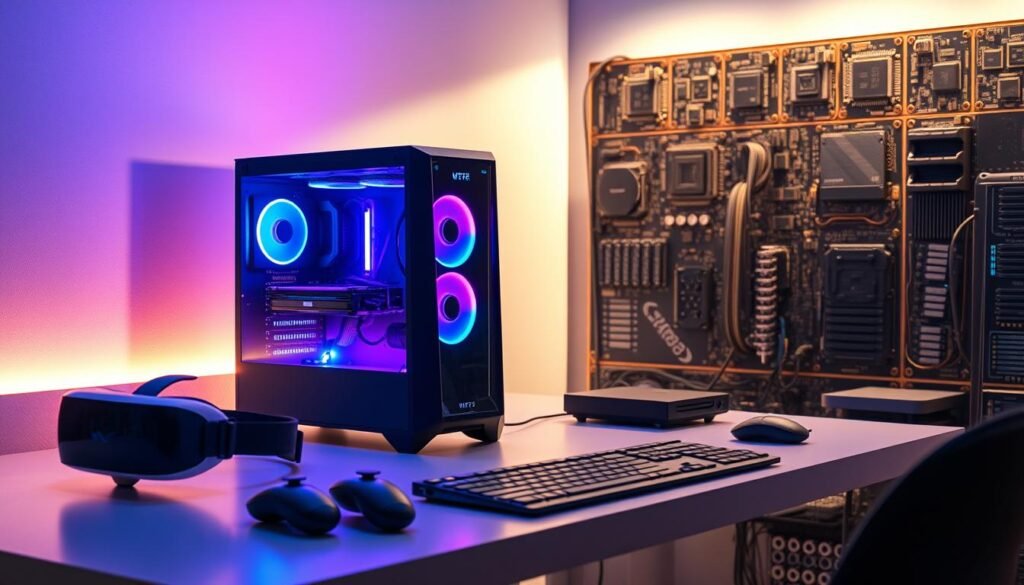
Major manufacturers like Dell’s Alienware, ASUS, MSI, HP’s OMEN, and Lenovo Legion drive this innovation. Their latest systems incorporate cutting-edge technologies that serve both gaming enthusiasts and AI professionals.
Innovative Hardware Components and Features
Today’s high-performance systems feature powerful GPUs with dedicated ray tracing cores and processors optimized for parallel computing. Advanced cooling solutions ensure these components operate at peak efficiency during intensive tasks.
Customizable RGB lighting and sleek designs appeal to gaming audiences while serving practical purposes for workstation users. These features represent the growing integration of form and function in modern computing devices.
Integration of AI for Enhanced Performance
Artificial intelligence now enhances system performance through intelligent optimization and predictive resource allocation. Software partners including Adobe, Microsoft, and Zoom enable over 300 AI-powered features.
These capabilities include real-time language translation, automated content creation, and privacy-preserving on-device processing. The result is smarter, more efficient computing experiences across various applications.
| Component Type | Gaming Focus | AI Focus |
|---|---|---|
| Graphics Processing | High frame rates, ray tracing | Neural network acceleration |
| Processor Design | Game optimization, speed | Parallel AI workload handling |
| Cooling Systems | Peak performance maintenance | Sustained computational efficiency |
| Feature Integration | Visual customization, RGB | Automated optimization tools |
These emerging trends indicate that future computing devices will be defined by their specialized hardware and intelligent capabilities. This creates compelling reasons for users to upgrade to the latest technology.
Regional Market Analysis
The global landscape for high-performance systems shows dramatic variations across continents and countries. Our regional examination reveals where current strength lies and where future expansion will likely occur.
North America and Europe Insights
North America captured 29.4% of the global gaming system share in 2024. This dominance stems from high disposable income and established gaming culture.
Thirty-five percent of U.S. households owned gaming computers in 2023. Europe represents another mature territory with Germany leading at 34% of regional hardware sales.
The United Kingdom follows closely, where gaming systems accounted for 15% of all computer sales in 2023. These developed regions provide stable revenue bases.
Opportunities in APAC, Latin America, and the Middle East
Asia-Pacific shows the highest growth potential with a projected 12.1% compound annual rate. China demonstrates 58% penetration among gamers in this region.
Latin America expands steadily with Brazil commanding 50% of the regional business. The Middle East and Africa show accelerating growth patterns.
Saudi Arabia’s Vision 2030 allocates $38 billion to become a global gaming hub. This investment signals significant future potential.
| Region | Current Market Share | Growth Projection | Key Driver |
|---|---|---|---|
| North America | 29.4% | Steady | Established user base |
| Europe | Substantial | Moderate | Germany leadership |
| Asia-Pacific | Growing | 12.1% CAGR | Manufacturing hub |
| Latin America | Expanding | Accelerating | Brazil dominance |
| Middle East/Africa | Moderate | Increasing | Saudi investment |
This regional data analysis helps you understand where the greatest opportunities lie. Emerging markets offer the most significant expansion potential for future years.
Market Segmentation and Product Insights
Understanding how different customer groups interact with computing hardware reveals powerful patterns. We can break down the landscape into distinct categories to identify growth opportunities.

This analysis helps manufacturers target specific audience needs effectively. Each segment tells a unique story about consumer preferences and future demand.
Product, Price Range, and End-User Divisions
Desktop systems dominated with 73.4% global share in 2024. Their superior performance appeals to serious gamers and professionals.
Laptop demand grows at 15.4% CAGR through 2033. Portability drives this trend, with 45% of gamers preferring mobile systems.
Mid-range devices captured 43.4% market share in 2024. They offer the best balance of price and performance for most users.
Low-range systems show the fastest growth at 18.2% CAGR. Emerging markets drive demand for affordable entry-level options.
Casual gamers represent 64.6% of the global market. Professional gamers show the highest growth at 15.7% CAGR.
AI-capable laptops hold 56.5% market share. Desktop AI systems grow at 40.6% CAGR for specialized workloads.
These segments reveal where manufacturers should focus development efforts. Understanding these patterns helps you make informed strategic decisions.
Forecasting the Future of PC and AI Integration
The architecture of modern computing is undergoing its most significant transformation since the advent of dedicated graphics processing. This shift mirrors the GPU revolution of two decades ago, but with artificial intelligence as the driving force. We’re witnessing a fundamental redesign of how systems process information.
You’ll see intelligent processors becoming as essential to computing as graphics cards became for visual performance. This integration represents more than just incremental improvement—it’s a complete paradigm shift in system design.
Technological Advancements Driving Innovation
Recent processor launches have established new standards for AI-capable systems. Intel’s Core Ultra and Qualcomm’s Snapdragon X Elite platforms feature dedicated neural processing units (NPUs) that handle AI workloads efficiently. These components work alongside traditional CPUs and GPUs in heterogeneous architectures.
The move to on-device AI processing brings substantial benefits. You gain enhanced privacy, reduced latency, and continuous functionality without cloud dependency. Over 300 AI-enhanced features from software partners like Adobe and Microsoft demonstrate practical applications.
Future advancements will focus on improving inference speed and expanding the range of AI workloads that run efficiently on local hardware. As these capabilities evolve, they’ll transition from premium features to standard expectations across all computing systems.
Evaluating Market Drivers and Restraints
The competitive gaming hardware sector faces a complex interplay of supportive policies and operational challenges that will determine future expansion. Understanding these forces helps you navigate the industry landscape effectively.
Government recognition and international events create strong momentum. Countries worldwide are embracing competitive gaming as a legitimate discipline.
Government Policies and Industry Support
Official recognition by governments in South Korea, China, and Indonesia validates esports. This support drives investment and consumer adoption.
Major events like the Olympic Virtual Series attracted over 250,000 participants. The Asian Games featured eight medal events with five million spectators. These platforms showcase high-performance systems to global audiences.
Saudi Arabia’s Vision 2030 allocates $1.1 billion for esports infrastructure. Such initiatives demonstrate strong institutional backing for the industry.

Supply Chain Challenges and Competitive Pressures
Significant obstacles temper the optimistic growth outlook. Mobile gaming captures 49% of the global market, while consoles hold 28%.
High costs present barriers for many consumers. Gaming systems range from $1,200 to $3,000 compared to consoles at $500-$600. Peripheral prices have risen 30% since 2020.
Supply chain disruptions create manufacturing challenges. Semiconductor shortages caused 20-30% price increases in 2021. Delivery times extended from 14 to over 26 weeks.
Energy consumption raises sustainability concerns. Gaming hardware represents only 2.5% of computers but uses 20% of computer energy. This data highlights operational challenges.
Understanding these drivers and restraints enables balanced strategies. You can leverage supportive policies while addressing cost and supply chain issues.
Analysis of Competitive Landscape
Competitive dynamics in the high-performance computing sector reveal a complex ecosystem where strategic positioning determines market success. The landscape features intense rivalry among established technology giants and specialized hardware manufacturers.
Leading Companies and Market Positioning
Major players like Dell’s Alienware and HP’s OMEN target premium segments with cutting-edge performance. Lenovo’s Legion series and ASUS ROG compete aggressively for gaming enthusiasts. These companies differentiate through unique design philosophies and target customer segments.
In the AI computing space, Apple integrates M-series chips while Microsoft drives the Copilot+ initiative. Intel and NVIDIA provide crucial acceleration technologies. Each company carves out distinct market positioning to capture specific customer needs.
Strategic Collaborations and Acquisitions
Partnerships reshape competitive dynamics significantly. Dell collaborated with Qualcomm for Snapdragon X Elite processors. Acer integrated NVIDIA’s RTX 50 Series in their latest offerings.
Recent acquisitions demonstrate industry consolidation trends. EQT’s £2 billion purchase of Keywords Studios expanded gaming services capabilities. NVIDIA’s “Project Digits” system represents vertical integration efforts. These moves blur traditional industry boundaries and create new competitive advantages.
Innovation remains the primary differentiator in this crowded market. Companies race to deliver next-generation capabilities that transform customer expectations.
Implications of Trade Policies and Regulatory Environment
International commerce frameworks are reshaping how technology companies approach manufacturing and distribution strategies. These policies create both constraints and opportunities within the global industry.
Impact of Tariffs and Trade Measures
Tariffs on imported semiconductors and advanced computing hardware have increased production costs significantly. This leads to price fluctuations and extended lead times for critical components.
Companies must reassess their global supply chain configurations to reduce exposure to trade-related disruptions. Many are moving toward regionally manufactured hardware to ensure production continuity.
Regional Regulatory Compliance and Its Effects
Compliance requirements vary dramatically across major markets. Data privacy regulations like GDPR in Europe create complex landscapes that companies must navigate.
Government initiatives such as the U.S. CHIPS Act promote domestic semiconductor manufacturing. These policies directly impact where and how components are produced.
As one industry analyst noted in a recent report:
“Companies aligning with regional policy priorities gain competitive advantages through subsidies and preferential market access.”
| Region | Key Regulations | Manufacturing Impact | Market Access |
|---|---|---|---|
| United States | CHIPS Act, Export Controls | Domestic production incentives | Preferential government contracts |
| European Union | GDPR, Chips Act | Local infrastructure development | Data compliance requirements |
| Asia-Pacific | Technology sovereignty initiatives | Supply chain diversification | Regional partnership structures |
Understanding this regulatory environment is essential for long-term strategy development. Policy changes can fundamentally alter competitive dynamics and create new opportunities.
Strategic Investments and Market Opportunities
Investment flows into advanced computing technologies demonstrate growing confidence in long-term sector expansion. Major financial commitments from corporate and government entities signal strong belief in the industry’s trajectory.
Investment Trends and Forecasted Opportunities
Capital deployment patterns reveal where industry leaders are placing their strategic bets. AMD’s $1.65 billion investment in its AI research facility in Germany exemplifies this trend. The project creates over 1,000 jobs while positioning for future demand.
Government initiatives like Saudi Arabia’s Vision 2030 allocate $38 billion specifically for gaming sector development. This establishes new regional hubs for technology adoption and esports infrastructure.
Emerging markets present compelling investment cases. Southeast Asia shows strong potential as disposable incomes rise and internet infrastructure improves. Singapore’s gaming sector spent $327 million in 2019 with upward trajectory.
| Investment Type | Key Examples | Growth Potential | Target Sectors |
|---|---|---|---|
| Corporate R&D | AMD Germany Facility | High | AI & High-Performance Computing |
| Government Initiatives | Saudi Vision 2030 | Medium-High | Gaming & Esports Infrastructure |
| Emerging Market Expansion | Southeast Asia Growth | High | VR/AR & Gaming Hardware |
| Technology Integration | VR/AR Applications | Medium-High | Entertainment & Healthcare |
Advanced technologies like virtual and augmented reality create additional investment opportunities. The U.S. Department of Commerce notes expanding applications across entertainment, shopping, and healthcare sectors. These developments require robust hardware capabilities.
Understanding these trends helps stakeholders identify high-potential segments. Companies can align capital deployment with areas offering strongest growth prospects.
Technological Disruptions and Industry Challenges
Sustainable expansion in high-performance computing requires overcoming two major hurdles: environmental impacts and supply chain vulnerabilities. These challenges threaten the industry’s impressive growth trajectory if not addressed strategically.
Energy Consumption and Environmental Impacts
High-performance systems face significant energy challenges. Gaming computers represent just 2.5% of the global computing base but consume approximately 20% of computer energy. This creates substantial environmental concerns.
Research shows energy demand could rise by 114% or decrease by 28% depending on user behavior and equipment choices. The industry must develop more power-efficient hardware architectures to balance performance with responsibility.
Mitigating Supply Chain Disruptions
Supply chain vulnerabilities present another critical challenge. The global semiconductor shortage caused 20-30% GPU price increases in 2021. Delivery times extended from 14 weeks to over 26 weeks during peak disruptions.
Effective solutions include diversifying supplier relationships and investing in onshore semiconductor manufacturing. Companies must develop closer partnerships with component manufacturers to secure priority allocation during shortage periods.
These strategic approaches help mitigate supply chain risks while supporting sustainable growth. The industry can navigate these challenges through collaborative innovation and responsible practices.
Comprehensive Data Analysis and Methodology
The credibility of any market forecast rests entirely on the strength of its underlying research methodology and data validation processes. Our approach combines multiple analytical frameworks to deliver reliable insights.
Research Approach and Data Synthesis
Our methodology employs global, regional, and country-level assessment. This multi-tiered research approach ensures comprehensive coverage across geographic boundaries.
We integrate segment-level analysis examining product categories and end-user groups. This granular perspective reveals specific growth opportunities within broader trends.
Advanced analytical frameworks form the core of our research. These tools provide multi-dimensional perspectives on competitive dynamics and market forces.
| Analytical Framework | Primary Focus | Key Insights Generated |
|---|---|---|
| DROC Analysis | Market Drivers & Restraints | Growth barriers and accelerators |
| PESTLE Analysis | External Environment | Policy and regulatory impacts |
| Porter’s Five Forces | Competitive Landscape | Industry rivalry and positioning |
| Adoption Lifecycle | Customer Behavior | Market penetration rates |
Data collection combines primary research with authoritative secondary sources. This dual approach captures both expert insights and verified factual information.
The resulting analysis provides actionable intelligence for strategic planning. Stakeholders can confidently base decisions on this rigorous research foundation.
Conclusion
Two parallel technological revolutions are converging to create unprecedented opportunities in the computing hardware sector. The entertainment and intelligence segments demonstrate distinct but complementary growth trajectories that will shape the industry’s future direction.
Our analysis reveals steady expansion in gaming systems alongside explosive growth in AI-capable hardware. This bifurcated pattern creates diverse opportunities across different customer segments and geographic regions. Emerging markets show particularly strong potential for future adoption.
The competitive landscape remains dynamic, requiring strategic responses to challenges like energy efficiency and supply chain management. Success will depend on understanding customer needs and delivering compelling value propositions. The ongoing innovation across entertainment, productivity, and enterprise sectors positions this industry for sustained expansion.